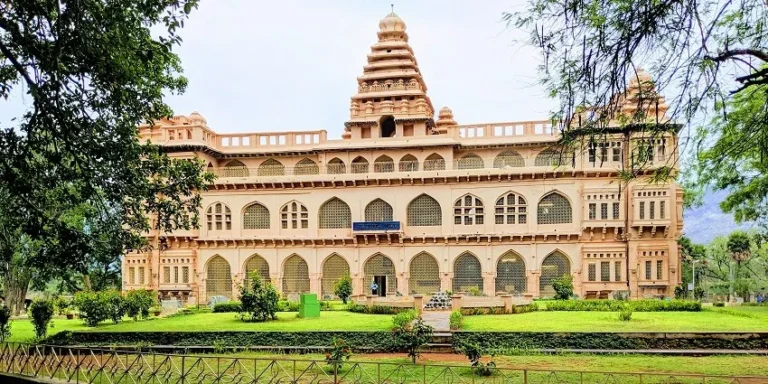
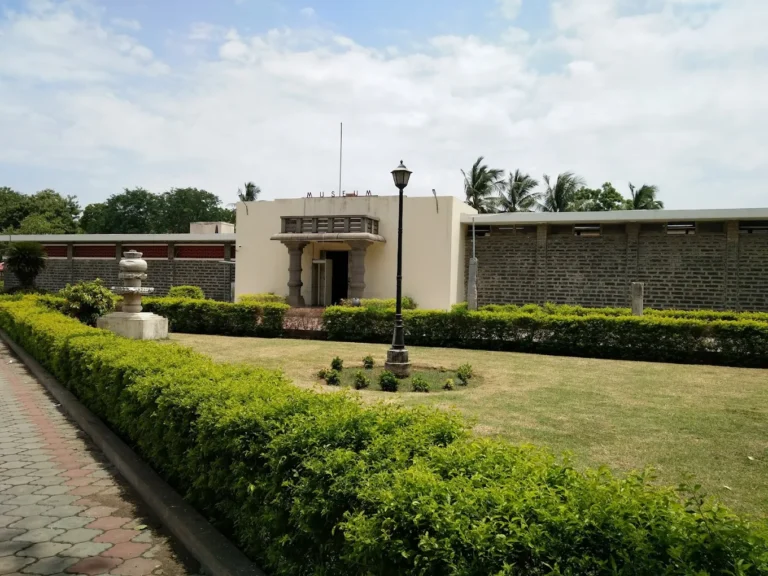
Located in the heart of Vijayawada along M.G. Road, the Bapu Museum (formerly known as the Victoria Jubilee Museum) is a premier destination for history enthusiasts, art lovers, and heritage seekers in Andhra Pradesh. Maintained by the Department of Archaeology & Museums, Government of Andhra Pradesh, this century-old institution bridges ancient regional heritage with modern interactive experiences.
Spanning thousands of years of human history—from prehistoric tools to royal weaponry—the museum showcases over 1,500 rare antiquities across nine state-of-the-art themed galleries. Beyond its artifacts, the museum ground holds a monumental place in India’s freedom struggle as the birthplace of the Indian National Flag design.
Historical Significance & National Heritage
The Golden Jubilee Heritage
The foundation stone of the main colonial building was laid on July 27, 1887, by Robert Sewell, the then District Collector of Krishna district, to commemorate the Golden Jubilee of Queen Victoria. Designed in an elegant Indo-European architectural style featuring fine ashlar masonry, it initially hosted industrial and technical exhibitions before being converted into an archaeological museum in 1962.
Birthplace of the Indian National Flag
The museum holds a sacred page in India’s freedom movement. In March 1921, during the All-India Congress Committee session held on these grounds, Pingali Venkayya presented a bicameral tricolour design to Mahatma Gandhi. Bapu subsequently added the Charkha (spinning wheel) to the center, creating the precursor flag that inspired India’s present-day national flag.
Why “Bapu” Museum?
While the grounds are tied to Mahatma Gandhi, the museum was officially renamed in 2015 to honor the legendary Telugu artist, film director, and cartoonist Sattiraju Laxminarayana, affectionately known as Bapu.
Major Galleries & Notable Artifacts
The indoor galleries are arranged chronologically and thematic-wise to present a seamless narrative of Andhra’s cultural evolution:
-
Prehistoric & Early Historical Era: Features Stone Age implements, celts, early pottery, and megalithic tools excavated across South India.
-
Buddhist & Jain Relics: Houses a iconic 3rd-century white limestone standing Buddha from Alluru and fine granite sculptures depicting various stages of the Buddha’s life.
-
Hindu Sculptural Gallery: Displays exquisite stone sculptures dating from the Satavahana, Ikshvaku, Eastern Chalukya, Kakatiya, and Vijayanagara periods. Highlights include a rare 2nd-century Mahishasuramardini (Durga) idol and an ancient Basalt Indra statue.
-
Arms & Armor: An evocative display of medieval swords, daggers, chainmail armor, shields, and firearms used by local rulers and royal guards.
-
Coins & Epigraphy: Gold, silver, and copper punch-marked coins, alongside stone inscriptions detailing royal decrees and royal genealogies.
-
Decorative & Folk Arts: Bidriware, celadon ceramics, terracotta figurines, royal cutlery, and traditional textiles.
-
Outdoor Sculpture Garden: The lush campus surrounds an open-air display of ancient temple pillars, hero stones (Veeragallu), and monolithic idols.
Modern Technology & Interactive Features
Following a comprehensive modernization overhaul, Bapu Museum stands out as one of India’s most tech-savvy archaeological spaces:
-
Augmented Reality (AR) Interactive Scans: Visitors can scan select sculptures using their smartphones to watch models animate and tell their historical backstories.
-
Digital Projection Books: Interactive digital books project rich media illustrating top global and regional heritage sites.
-
Interactive Kiosks & Quizzes: Fun, educational quiz stations at the gallery exits reward visitors and students with digital certificates.